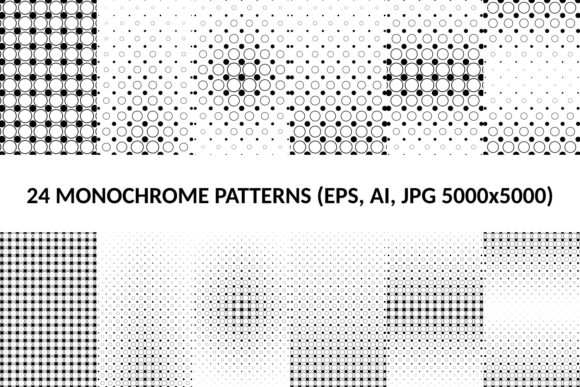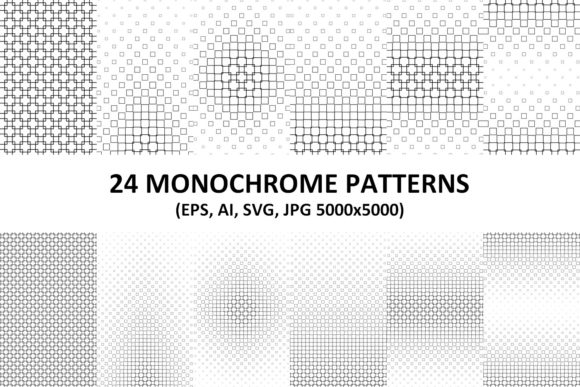
24 Monochrome Square Patterns
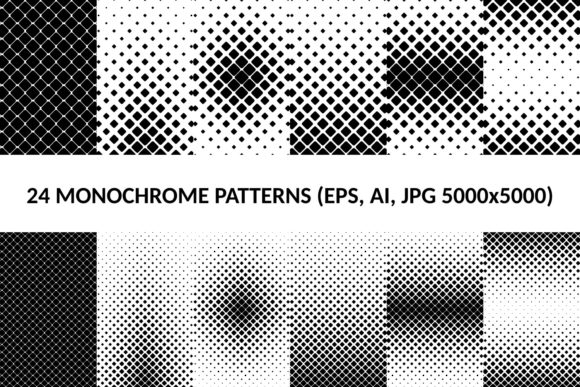
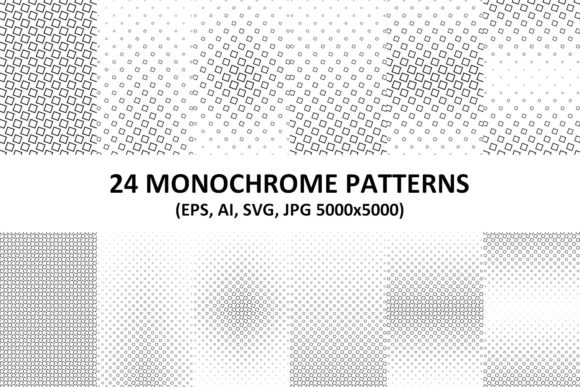
Few design resources manage to be both versatile and instantly usable. A set of monochrome square patterns, when executed well, can transform a project from ordinary to polished with minimal effort. The collection of 24 Monochrome Square Patterns offers exactly this kind of utility, delivering a curated library of black-and-white geometric designs that work across print, digital, branding, and editorial contexts. What sets this package apart is not just the visual consistency of the patterns themselves, but the breadth of formats included: 24 vector AI files, 24 vector EPS files, 24 vector SVG files, and 24 high-resolution JPG images at 5000 by 5000 pixels. That combination of format variety and resolution gives you flexibility no matter what tools you use or where the final output lives.
Understanding what this collection actually contains helps clarify where it fits into a real workflow. The 24 patterns are monochrome, meaning each one relies on contrast between black, white, and shades of gray rather than color. That constraint is a strength, not a limitation. Monochrome patterns tend to hold up better across media because they do not rely on color calibration, printer profiles, or screen accuracy. They also scale gracefully, integrate easily into layouts with existing color schemes, and communicate a clean, modern aesthetic that works especially well for professional applications. The square format adds further predictability. Each pattern occupies a consistent shape, which makes tiling, repeating, and aligning them in grids or layouts straightforward.
The package structure deserves close attention because it directly affects how you can use the files. Each of the 24 patterns is available as a vector AI file, a vector EPS file, a vector SVG file, and a JPG at 5000 by 5000 pixels. That means you have four different entry points into the same design. If you work in Adobe Illustrator, the AI files give you full editability. If you use Affinity Designer, CorelDRAW, or another vector application that handles EPS reliably, the EPS files offer a universal fallback. If you build for the web or need lightweight scalable graphics for user interfaces, the SVG files are ready to drop into code or design tools. And if you need a raster version for immediate use in image editors or for print mockups, the 5000 by 5000 JPG files give you enough resolution for large format output without any scaling artifacts.
Why format variety matters for real projects
When you purchase a pattern set, the format support often determines whether the resource becomes a go-to tool or just another download folder. The 24 Monochrome Square Patterns package addresses this by covering the most common workflows in one go. For a freelance designer who moves between Adobe Illustrator for branding work and Figma for web mockups, having both AI and SVG versions means no conversion steps, no quality loss, and no rework. For a small business owner who needs to create social media graphics, product packaging mockups, and printed marketing materials, the EPS files provide a print-ready vector format while the JPG versions allow quick placement in tools like Canva or PowerPoint. That kind of cross-platform readiness saves time in a very practical sense.
Resolution is another factor that separates a useful pattern set from a frustrating one. At 5000 by 5000 pixels, the JPG files offer enough detail for posters, banners, signage, and even large format prints at moderate resolution. If you need to fill a texture background for a website hero section, that resolution gives you crisp edges even on retina displays. The vector files, of course, are resolution-independent, so you can scale them up to any size without degradation. Having both options means you can choose the fastest path for each specific task rather than fighting with format conversion or resolution limits.
Practical outcomes for different creative roles
The real value of a pattern collection like this shows up differently depending on who uses it and what they need to accomplish. For a marketer building a brand identity, monochrome square patterns can serve as subtle texture elements in packaging, stationery, or website backgrounds. Because they lack color, they layer well behind colored text, logos, or imagery without creating visual noise. A pattern that uses clean line work or repeating geometric motifs can reinforce a brand language without competing with other elements on the page.
For an educator or instructional designer, these patterns offer a way to add visual interest to worksheets, slide decks, or handouts without introducing distractions. A monochrome pattern applied as a half-tone texture or a subtle grid can make a page feel more finished while keeping the focus on the content. The SVG format is especially useful here because it allows scaling to any size without bloating file sizes, which matters when you are preparing digital materials for distribution or embedding in online courses.
For a blogger or content creator, the patterns can serve as repeating backgrounds for social media graphics, YouTube thumbnails, or email headers. Monochrome designs photograph well and screen-print reliably, so if you create physical merchandise or print-on-demand products, these patterns give you a library of ready-to-use textures that avoid the complexity of color matching. The 5000 by 5000 pixel JPG files are particularly useful for print-on-demand platforms that require high-resolution uploads for products like phone cases, mugs, or art prints.
Use cases that reveal the collection’s strengths
Consider a scenario where you are designing a set of business cards for a consulting firm. The client wants a modern, minimalist look that stands out but remains professional. A monochrome square pattern used as a subtle background texture on one side of the card provides visual interest without overwhelming the contact information. You can take the EPS file into Illustrator, scale it to fit the card dimensions, adjust the opacity, and output a print-ready file. The same pattern can then be used on the company website as a SVG background element, creating visual continuity across print and digital touchpoints.
Another example involves a freelance designer creating a pattern library for a client’s brand guidelines. The 24 patterns give you enough variety to recommend different textures for different applications, such as a tighter grid pattern for packaging and a more open geometric motif for website backgrounds. Because all patterns share a monochrome palette and square format, they feel cohesive even when they look different. That coherence helps maintain brand consistency without requiring every application to use the exact same visual treatment.
For an entrepreneur launching a product line, these patterns can be applied to packaging inserts, thank you cards, or social media templates. The monochrome aesthetic works well with almost any packaging color, from kraft paper to bright metallics. The ability to open an SVG file directly in a browser or a design tool like Canva (which supports SVG uploads in some plans) means you can create polished assets without needing expensive software on every device.
Who benefits most from this collection
The people who will find the most value in this package are those who frequently need repeating textures or backgrounds but do not have the time or inclination to create them from scratch. Freelance designers who take on varied projects benefit from having a go-to set of patterns that work across different client needs. Small business owners who handle their own marketing materials gain access to professional-grade assets without needing to hire a designer for every layout. Educators and instructional designers who produce worksheets, presentations, and handouts will appreciate the consistency and scalability of vector patterns that look crisp at any size.
Hobbyists and crafters who use design software for personal projects will also find the collection accessible. The SVG files work in free tools like Inkscape or Gravit Designer, and the JPG files can be used in virtually any image editor. The monochrome nature of the patterns makes them easy to recolor if needed, either by applying filters in raster software or by editing the vector fills directly in a vector application.
Thoughtful considerations before purchasing
While the 24 Monochrome Square Patterns offer a strong balance of variety and format support, there are a few factors worth evaluating based on your specific needs. First, the patterns are monochrome by design. If your work requires vibrant color patterns or multicolor textures, this collection will not serve that need. However, because the patterns are delivered as editable vectors in AI and EPS formats, you can easily change the stroke and fill colors if you want to introduce a brand color or a gradient. The monochrome starting point actually makes recoloring simpler because there are no complex color interactions to untangle.
Second, the square format is consistent across all patterns. This is beneficial for tiling and alignment, but if you need irregularly shaped patterns or non-square aspect ratios, you may need to crop or mask the squares to fit your layout. The vector files make cropping straightforward, as you can simply place the pattern inside a clipping mask or use a pattern fill swatch in applications that support it.
Third, the 24 patterns provide a focused but not exhaustive library. If you need hundreds of variations, this set will likely serve as a foundation rather than a standalone solution. For most professional and personal projects, however, 24 well-designed patterns that are available in four different formats each give you 96 immediately usable assets, which is a practical quantity for building a design system or stocking a resource library.
Making the most of the package
To get the highest return from this collection, consider organizing the files by format and by pattern style. Keep the AI and EPS folders handy for client work that requires editability. Use the SVG files for web-based tools and rapid prototyping. Store the JPG files as ready-to-place backgrounds for projects where you do not need to modify the pattern, such as social media templates or print-ready layouts. Because all files are named consistently, you can quickly locate the same pattern across formats without confusion.
If you work in a team, the variety of formats also supports collaborative workflows. A graphic designer can edit the AI file while a web developer uses the SVG version for production. A marketing coordinator can drop the JPG into a presentation deck without needing access to design software. This format flexibility eliminates common friction points where one team member cannot open or use a file created by another.
Ultimately, the 24 Monochrome Square Patterns deliver what a good design resource should: clarity, consistency, and compatibility. The monochrome aesthetic removes the risk of color clashes, the square format simplifies layout decisions, and the four-file format coverage ensures you can use the patterns wherever your work takes you. Whether you are designing a brand identity, preparing educational materials, building a website, or creating print-on-demand products, this collection provides a solid foundation of textures that require minimal adjustment to look professional.