Seamless Patterns with Life Buoy: Design Elements for Fabric and Print
Seamless patterns with life buoy motifs offer a distinctive visual language rooted in maritime symbolism, safety, and coastal aesthetics. These repeatable design elements, often rendered in red and white color schemes, serve as versatile assets for fabric printing, surface decoration, and digital media. Understanding how to integrate these patterns into your workflow requires more than a basic appreciation of their appearance—it demands a practical grasp of their structural behavior, compatibility with production methods, and strategic placement within a project's lifecycle.
Whether you are a textile designer, a surface pattern creator, a small business owner producing custom merchandise, or a graphic artist building a themed collection, knowing when and how to deploy seamless patterns with life buoy elements can significantly affect your output's consistency, efficiency, and visual impact.
What Seamless Patterns with Life Buoy Deliver in Practice
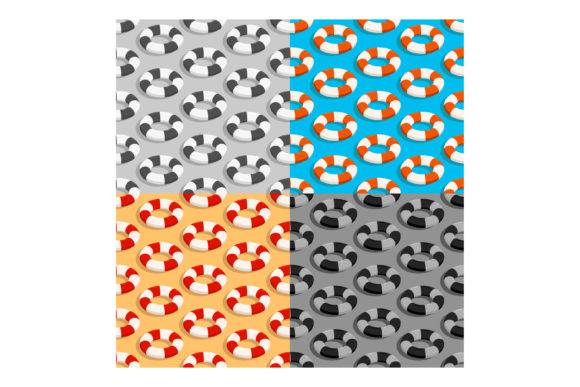
At their core, seamless patterns with life buoy motifs are vector-based repeating tiles where the buoy element—typically the classic ring shape with alternating red and white segments—repeats edge-to-edge without visible seams. The seamless property is critical for fabric printing, wallpaper, wrapping paper, and any surface where uninterrupted repetition is required. The life buoy itself functions as both a literal object and a graphic icon carrying connotations of rescue, maritime life, and nautical heritage.
These patterns typically incorporate additional supporting elements such as ropes, anchors, waves, stars, or typographic details. The red and white color combination is both historically accurate for maritime safety equipment and visually striking for decorative use. When prepared correctly, the vector file allows infinite scaling without resolution loss, making it suitable for both small-scale prints and large-format applications.
In a practical workflow, these patterns serve as modular building blocks. You can import them into design software, adjust colorways, overlay them on product mockups, or combine them with other pattern layers. Their vector format means they integrate smoothly with tools like Adobe Illustrator, Affinity Designer, CorelDRAW, and even simpler platforms like Canva or Inkscape when properly exported.
Positioning Life Buoy Patterns Across a Project Timeline
Integrating seamless patterns with life buoy motifs into a project follows a natural arc. Understanding where each phase of engagement occurs helps you allocate time, resources, and creative energy effectively.
Before the Project: Preparation and Asset Curation
In the pre-production phase, the pattern functions as a design brief component or a visual anchor. You might start by curating a selection of red and white life buoy patterns that align with your intended mood—vintage nautical, modern minimalist, playful coastal, or safety-themed industrial. This curation step is essential because the pattern's density, scale, and supporting elements influence everything from fabric weight to print registration.
If you are a print-on-demand seller, for example, reviewing how the pattern behaves at different repeat sizes before committing to a product run saves time and materials. If you are an educator preparing classroom materials about pattern design, having a clean vector pattern on hand demonstrates real-world repetition logic without needing to build one from scratch.
Preparation also involves checking the pattern's compatibility with your production pipeline. Vector seamless patterns with life buoy elements usually come as .ai, .eps, .svg, or .pdf files. Confirm that your software version supports the file format and that the pattern swatch is properly defined—not just a manually tiled group of elements. A true seamless swatch saves you from having to align edges yourself.
During the Project: Active Integration and Iteration
Once a project is underway, the pattern moves from a passive asset to an active design element. This is where most of the creative decision-making happens. You might apply the pattern as a fill to a shape, map it onto a 3D product mockup, use it as a background for branding materials, or print it directly onto fabric for apparel or home decor.
During this phase, attention to scale and rotation becomes critical. A life buoy pattern that looks balanced on a digital screen may feel too large or too small when printed on a tote bag or a dress panel. Use your software's preview functions to test multiple scales. Some designers create three versions of the same pattern—large, medium, and small repeats—to accommodate different product dimensions without losing the motif's recognizability.
Color adjustment also happens here. While the classic red and white combo is iconic, you may need to shift hues for brand consistency, seasonal collections, or printing constraints. If you are printing on dark fabric, for instance, red may appear muted and white may require an underbase. Simulate these conditions digitally before sending files to production. Vector patterns make global color changes straightforward, allowing you to test a navy-and-white or red-and-cream variant in minutes.
Integration with other tools also occurs during this stage. You might layer the life buoy pattern over a solid background in Photoshop, combine it with distressed textures in Procreate, or use it as a clipping mask for typography. The seamlessness ensures that these composite layers stack cleanly without visual breaks at tile boundaries.
After the Project: Quality Control and Asset Management
Post-production is often overlooked, but it determines whether your seamless pattern with life buoy performs reliably at scale. After finalizing your design, run a consistency check. Zoom out and scroll across the pattern to confirm no unintended lines, gaps, or color shifts appear at tile edges. If the pattern was modified during the project—for example, if you rotated elements or resized the swatch—verify that seamlessness is preserved. Some software handles pattern transforms poorly and introduces offsets.
Another practical step is to document the pattern's specifications: original dimensions, color values (HEX, CMYK, or Pantone), file format, and intended use case. This metadata becomes invaluable when you revisit the pattern months later for a new product line or a client requests adjustments. Organize your pattern library with clear naming conventions—for example, "LifeBuoy_RedWhite_SmallRepeat.ai"—so that you and your team can locate assets quickly without opening every file.
If you distribute patterns to collaborators, clients, or printing partners, include a brief usage note explaining the seamlessness, the recommended DPI for print, and any color profile expectations. This reduces back-and-forth and ensures the pattern reproduces as intended.
Practical Implementation Tips for Common Workflows
The value of seamless patterns with life buoy elements becomes most apparent when you apply them to specific real-world scenarios. Below are workflow examples that demonstrate how these patterns fit into different creative and commercial processes.
Textile and Fashion Production
For garment makers, the pattern's repeat size directly affects fabric layout and waste. A smaller repeat (2–4 inches) works well for all-over prints on shirts, dresses, and swimwear, while a larger repeat (6–12 inches) suits statement pieces like jackets, beach towels, or canvas bags. When ordering digitally printed fabric, request a strike-off sample first. This physical proof reveals how the red and white tones read under natural and artificial light and whether the pattern's scale matches the garment's proportions.
If you manufacture in bulk, provide your printer with the seamless vector file and specify the repeat direction—half-drop, brick, or straight repeat. Life buoy patterns often work best in a half-drop layout because the staggered arrangement echoes the organic feel of water and waves, reducing visual monotony.
Home Decor and Surface Design
Wallpaper, wrapping paper, and home accessories benefit from the pattern's seamlessness because visible joints ruin the immersive effect. When applying a life buoy pattern to a wallpaper design, consider the room's scale. A busy, high-density pattern suits accent walls or powder rooms, while a more open repeat with breathing space works for larger areas. Use your software's tiling preview to simulate a full wall section. If the pattern includes ropes or line work, check that these elements align across repeats without abrupt cuts.
For ceramic tiles or laminated surfaces, the pattern must also account for physical seams between tiles. In these cases, a seamless digital pattern ensures that the visual continuity holds across multiple tiles, even if the physical grout lines interrupt it slightly. Provide the tile manufacturer with the pattern at actual size and include a grout color recommendation if applicable.
Digital Media and Branding
Seamless patterns with life buoy motifs also serve digital applications—website backgrounds, social media templates, email headers, and video overlays. For digital use, the pattern must be optimized for screen resolution (72–150 DPI) and exported as a lightweight PNG or SVG. SVG is particularly valuable because it retains vector scalability and file size efficiency, making your site load faster without sacrificing visual quality.
If you use the pattern as a background for a brand identity, ensure sufficient contrast with text overlays. The red and white palette can be high-energy but may compete with content. Adding a semi-transparent overlay or adjusting the pattern's opacity creates separation while preserving the maritime feel.
Organizing and Maintaining a Pattern Library
Long-term use of seamless patterns with life buoy elements depends on systematic organization. Designers and small business owners often accumulate dozens of patterns over time. Without structure, finding the right asset becomes inefficient. Consider building a pattern library organized by theme (nautical, safety, coastal), color palette (red-white, navy-white, monochrome), and scale (small, medium, large).
Use cloud storage with version history so that edits—such as recoloring or resizing—are tracked. If you work with a team, define a standard file format for source files (preferably .ai or .eps) and a separate folder for exports (PNG, JPG, SVG). Include a README or spreadsheet that lists each pattern's properties, including file size, repeat dimensions, and any known limitations.
Regularly audit your library to archive outdated patterns and flag those with high usage. This practice keeps your workflow lean and prevents you from accidentally using a low-resolution or corrupted file in a production run.
Efficiency Gains from Proper Preparation
The real advantage of working with seamless patterns with life buoy motifs emerges when you have prepared them correctly upfront. A well-constructed vector pattern eliminates hours of manual alignment, reduces material waste in sample printing, and allows rapid iteration across colorways and scales. This efficiency matters whether you are a solo freelancer managing tight deadlines or a team producing multiple product SKUs under a single brand umbrella.
By understanding the pattern's behavior in your specific workflow—before, during, and after production—you transform a decorative asset into a reliable production tool. The life buoy motif, with its strong visual identity and maritime heritage, becomes more than ornamentation. It becomes a consistent, scalable component of your creative output, ready to perform across fabric, paper, screen, and surface.
Approach each pattern with the same care you would any production element: test early, document thoroughly, and scale deliberately. That discipline ensures that every seamless pattern you use enhances your work rather than introducing complications. Whether you are printing fabric for a coastal apparel line or designing wrapping paper for a nautical-themed collection, the life buoy pattern delivers both visual impact and practical reliability when integrated thoughtfully into your process.